
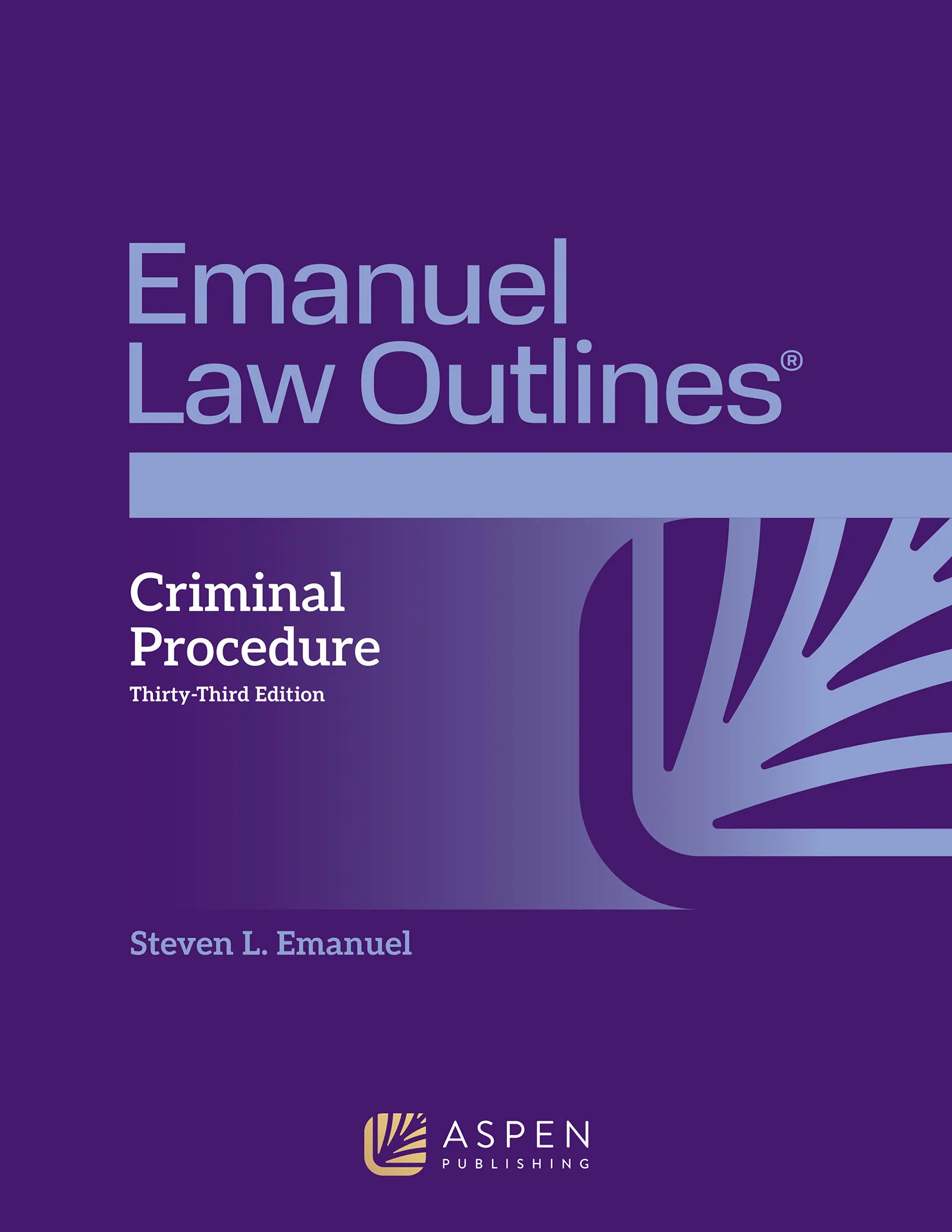
Emanuel Law Outlines for Criminal Procedure, Thirty-third Edition
Any law school graduate will tell you that when picking your outline tool, you need to pick the best because your outlines are the most important study tool you will use throughout your law school career. Developed by legendary study aid author Steve Emanuel, Emanuel® Law Outlines (ELOs) are the #1 outline choice among law students.
An ELO ensures that you understand the concepts as you learn them in class and helps you study for exams throughout the semester. Here's why you need an ELO from your first day of class right through your final exam:
ABOUT THE BOOK—TOOLS TO SUCCEED
- The Capsule Summary provides a quick reference summary of the key concepts covered in the full Outline.
- The detailed course Outline with black letter principles supplements your casebook reading throughout the semester and gives structure to your own outline.
- The Quiz Yourself feature includes a series of short-answer questions and sample answers to help you test your knowledge of the chapter’s content.
- Exam Tips alert you to issues and commonly used fact patterns found on exams.
- A Casebook Correlation Chart that correlates each section in the Outline with the pages covering that topic in the major casebooks.
In this new edition of Emanuel Law Outlines® for Criminal Procedure, professors and students will benefit from new and expanded coverage, including:
- Recent lower-court cases interpreting the 2018 decision in Carpenter v. U.S., under which government demands for a suspect’s personal data held by a non-governmental third-party (e.g., a cellphone company) must sometimes be supported by a search warrant and probable cause.
- Mitchell v. Wisconsin, holding that police do not require a search warrant before performing a blood-alcohol test of a driver who is so drunk as to be unconscious.
- 42 U.S.C. §1983, a statute that sometimes allows people whose Fourth Amendment or other constitutional rights have been violated by a police officer to bring a civil suit for money damages against the officer.
- Samia v. U.S., covering the situation in which D1 and D2 are tried together for the same crime, and the prosecution wants to present to the jury a confession by D1 (who doesn’t take the stand) that also implicates D2. Samia makes it much easier for prosecutors to present D1’s confession with only slight redactions of the portions that implicate D2, without thereby violating D2’s Confrontation Clause rights.
- Claims of “selective prosecution,” including why it’s virtually impossible for a defendant to successfully assert such claims.
Any law school graduate will tell you that when picking your outline tool, you need to pick the best because your outlines are the most important study tool you will use throughout your law school career. Developed by legendary study aid author Steve Emanuel, Emanuel® Law Outlines (ELOs) are the #1 outline choice among law students.
An ELO ensures that you understand the concepts as you learn them in class and helps you study for exams throughout the semester. Here's why you need an ELO from your first day of class right through your final exam:
ABOUT THE BOOK—TOOLS TO SUCCEED
- The Capsule Summary provides a quick reference summary of the key concepts covered in the full Outline.
- The detailed course Outline with black letter principles supplements your casebook reading throughout the semester and gives structure to your own outline.
- The Quiz Yourself feature includes a series of short-answer questions and sample answers to help you test your knowledge of the chapter’s content.
- Exam Tips alert you to issues and commonly used fact patterns found on exams.
- A Casebook Correlation Chart that correlates each section in the Outline with the pages covering that topic in the major casebooks.
In this new edition of Emanuel Law Outlines® for Criminal Procedure, professors and students will benefit from new and expanded coverage, including:
- Recent lower-court cases interpreting the 2018 decision in Carpenter v. U.S., under which government demands for a suspect’s personal data held by a non-governmental third-party (e.g., a cellphone company) must sometimes be supported by a search warrant and probable cause.
- Mitchell v. Wisconsin, holding that police do not require a search warrant before performing a blood-alcohol test of a driver who is so drunk as to be unconscious.
- 42 U.S.C. §1983, a statute that sometimes allows people whose Fourth Amendment or other constitutional rights have been violated by a police officer to bring a civil suit for money damages against the officer.
- Samia v. U.S., covering the situation in which D1 and D2 are tried together for the same crime, and the prosecution wants to present to the jury a confession by D1 (who doesn’t take the stand) that also implicates D2. Samia makes it much easier for prosecutors to present D1’s confession with only slight redactions of the portions that implicate D2, without thereby violating D2’s Confrontation Clause rights.
- Claims of “selective prosecution,” including why it’s virtually impossible for a defendant to successfully assert such claims.
Original: $33.99
-65%$33.99
$11.90Description
Any law school graduate will tell you that when picking your outline tool, you need to pick the best because your outlines are the most important study tool you will use throughout your law school career. Developed by legendary study aid author Steve Emanuel, Emanuel® Law Outlines (ELOs) are the #1 outline choice among law students.
An ELO ensures that you understand the concepts as you learn them in class and helps you study for exams throughout the semester. Here's why you need an ELO from your first day of class right through your final exam:
ABOUT THE BOOK—TOOLS TO SUCCEED
- The Capsule Summary provides a quick reference summary of the key concepts covered in the full Outline.
- The detailed course Outline with black letter principles supplements your casebook reading throughout the semester and gives structure to your own outline.
- The Quiz Yourself feature includes a series of short-answer questions and sample answers to help you test your knowledge of the chapter’s content.
- Exam Tips alert you to issues and commonly used fact patterns found on exams.
- A Casebook Correlation Chart that correlates each section in the Outline with the pages covering that topic in the major casebooks.
In this new edition of Emanuel Law Outlines® for Criminal Procedure, professors and students will benefit from new and expanded coverage, including:
- Recent lower-court cases interpreting the 2018 decision in Carpenter v. U.S., under which government demands for a suspect’s personal data held by a non-governmental third-party (e.g., a cellphone company) must sometimes be supported by a search warrant and probable cause.
- Mitchell v. Wisconsin, holding that police do not require a search warrant before performing a blood-alcohol test of a driver who is so drunk as to be unconscious.
- 42 U.S.C. §1983, a statute that sometimes allows people whose Fourth Amendment or other constitutional rights have been violated by a police officer to bring a civil suit for money damages against the officer.
- Samia v. U.S., covering the situation in which D1 and D2 are tried together for the same crime, and the prosecution wants to present to the jury a confession by D1 (who doesn’t take the stand) that also implicates D2. Samia makes it much easier for prosecutors to present D1’s confession with only slight redactions of the portions that implicate D2, without thereby violating D2’s Confrontation Clause rights.
- Claims of “selective prosecution,” including why it’s virtually impossible for a defendant to successfully assert such claims.