
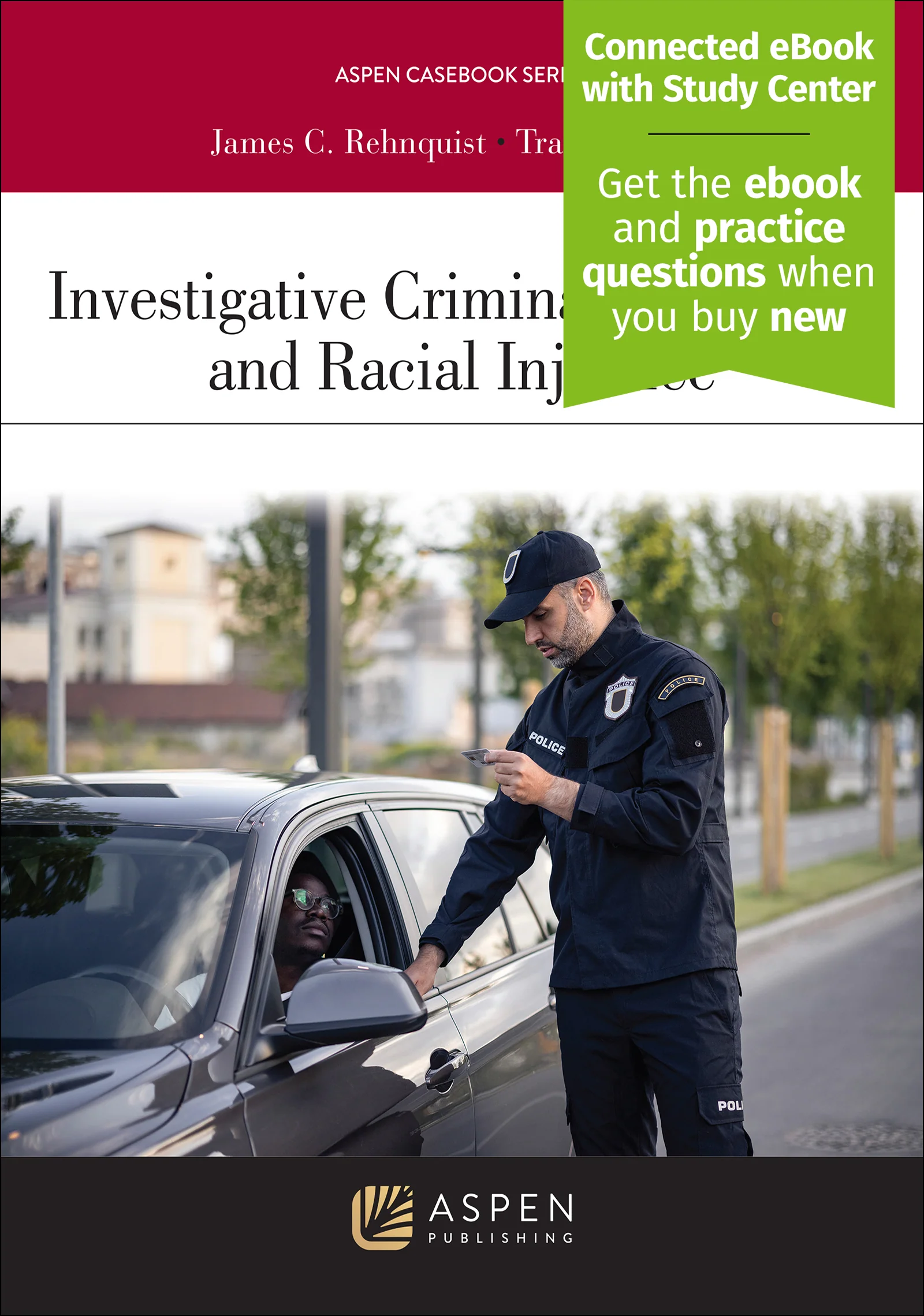
Investigative Criminal Procedure and Racial Injustice, First Edition
Buy a new version of this textbook and receive access to the Connected eBook with Study Center on Casebook Connect, including academic lifetime access to the online ebook with highlight, annotation, and search capabilities. Access also includes practice questions, an outline tool, and other helpful resources. Connected eBooks provide what you need most to be successful in your law school classes.
Investigative Criminal Procedure and Racial Injustice brings a sustained emphasis on race to the traditional content of criminal procedure. Rather than a wholesale revision of the standard criminal procedure fare, it amply covers all the familiar subject matter areas while integrating into those topics the roles that racial prejudice and racial disparities have played and continue to play in the criminal justice system.
The Investigative volume, from Chapters I-VII of Rehnquist/Maclin’s Criminal Procedure and Racial Injustice, looks deeply into the role that race—mostly implicitly—played not only in the Court’s written decision of Terry v. Ohio but also in the trial and appellate advocacy that produced that decision, including the direct and cross-examinations in the suppression hearing.
A secondary focus of the book is lawyering—the decisions and tactics of the prosecutors and defense lawyers that undergird the cases in the book. To that end, the plentiful Notes and Questions following the cases provoke thought and discussion not only on the relevant legal doctrine and the racial implications of the doctrine, but also on the choices made by the prosecutors and defense counsel.
Benefits for instructors and students:
- Flexible organization
- Interesting, timely cases
- Sophisticated, robust notes and questions following each case
- Investigative chapters:
- Police Interrogation and the Fifth Amendment—the scope of the Fifth Amendment privilege; the backdrop for and decision in Miranda v. Arizona; the implementation of Miranda’s custody; interrogation and waiver/assertion components; and the durability of Miranda
- The Fourth Amendment—the definitions of search and seizure; the “warrant requirement” and its exceptions; and the landmark case of Terry v. Ohio and its legacies for racial profiling, traffic stops, etc.
- The Exclusionary Rule—the origins of the rule and its exceptions (good faith, attenuation, standing, etc.) and including a section on suppression hearings
- The Grand Jury—its purported independence, informality, and secrecy; its virtually unlimited power to subpoena witnesses and documents; and grand jury abuse
- Addressing Police Misconduct—an unconventional chapter exploring the Supreme Court’s resurrection of 42 U.S.C. § 1983 as a private remedy for civil rights violations, the victims of which are disproportionately members of minority groups; the Court’s subsequent weakening of that remedy through doctrines such as qualified immunity; and the Department of Justice’s administrative remedy to address a “pattern and practice” of police misconduct under 42 U.S.C. § 14141. This subject has become increasingly important in the Criminal Procedure realm as recent Supreme Court decisions rejecting application of the exclusionary rule have sometimes cited § 1983 as an adequate alternative remedy.
Buy a new version of this textbook and receive access to the Connected eBook with Study Center on Casebook Connect, including academic lifetime access to the online ebook with highlight, annotation, and search capabilities. Access also includes practice questions, an outline tool, and other helpful resources. Connected eBooks provide what you need most to be successful in your law school classes.
Investigative Criminal Procedure and Racial Injustice brings a sustained emphasis on race to the traditional content of criminal procedure. Rather than a wholesale revision of the standard criminal procedure fare, it amply covers all the familiar subject matter areas while integrating into those topics the roles that racial prejudice and racial disparities have played and continue to play in the criminal justice system.
The Investigative volume, from Chapters I-VII of Rehnquist/Maclin’s Criminal Procedure and Racial Injustice, looks deeply into the role that race—mostly implicitly—played not only in the Court’s written decision of Terry v. Ohio but also in the trial and appellate advocacy that produced that decision, including the direct and cross-examinations in the suppression hearing.
A secondary focus of the book is lawyering—the decisions and tactics of the prosecutors and defense lawyers that undergird the cases in the book. To that end, the plentiful Notes and Questions following the cases provoke thought and discussion not only on the relevant legal doctrine and the racial implications of the doctrine, but also on the choices made by the prosecutors and defense counsel.
Benefits for instructors and students:
- Flexible organization
- Interesting, timely cases
- Sophisticated, robust notes and questions following each case
- Investigative chapters:
- Police Interrogation and the Fifth Amendment—the scope of the Fifth Amendment privilege; the backdrop for and decision in Miranda v. Arizona; the implementation of Miranda’s custody; interrogation and waiver/assertion components; and the durability of Miranda
- The Fourth Amendment—the definitions of search and seizure; the “warrant requirement” and its exceptions; and the landmark case of Terry v. Ohio and its legacies for racial profiling, traffic stops, etc.
- The Exclusionary Rule—the origins of the rule and its exceptions (good faith, attenuation, standing, etc.) and including a section on suppression hearings
- The Grand Jury—its purported independence, informality, and secrecy; its virtually unlimited power to subpoena witnesses and documents; and grand jury abuse
- Addressing Police Misconduct—an unconventional chapter exploring the Supreme Court’s resurrection of 42 U.S.C. § 1983 as a private remedy for civil rights violations, the victims of which are disproportionately members of minority groups; the Court’s subsequent weakening of that remedy through doctrines such as qualified immunity; and the Department of Justice’s administrative remedy to address a “pattern and practice” of police misconduct under 42 U.S.C. § 14141. This subject has become increasingly important in the Criminal Procedure realm as recent Supreme Court decisions rejecting application of the exclusionary rule have sometimes cited § 1983 as an adequate alternative remedy.
Original: $33.99
-65%$33.99
$11.90Description
Buy a new version of this textbook and receive access to the Connected eBook with Study Center on Casebook Connect, including academic lifetime access to the online ebook with highlight, annotation, and search capabilities. Access also includes practice questions, an outline tool, and other helpful resources. Connected eBooks provide what you need most to be successful in your law school classes.
Investigative Criminal Procedure and Racial Injustice brings a sustained emphasis on race to the traditional content of criminal procedure. Rather than a wholesale revision of the standard criminal procedure fare, it amply covers all the familiar subject matter areas while integrating into those topics the roles that racial prejudice and racial disparities have played and continue to play in the criminal justice system.
The Investigative volume, from Chapters I-VII of Rehnquist/Maclin’s Criminal Procedure and Racial Injustice, looks deeply into the role that race—mostly implicitly—played not only in the Court’s written decision of Terry v. Ohio but also in the trial and appellate advocacy that produced that decision, including the direct and cross-examinations in the suppression hearing.
A secondary focus of the book is lawyering—the decisions and tactics of the prosecutors and defense lawyers that undergird the cases in the book. To that end, the plentiful Notes and Questions following the cases provoke thought and discussion not only on the relevant legal doctrine and the racial implications of the doctrine, but also on the choices made by the prosecutors and defense counsel.
Benefits for instructors and students:
- Flexible organization
- Interesting, timely cases
- Sophisticated, robust notes and questions following each case
- Investigative chapters:
- Police Interrogation and the Fifth Amendment—the scope of the Fifth Amendment privilege; the backdrop for and decision in Miranda v. Arizona; the implementation of Miranda’s custody; interrogation and waiver/assertion components; and the durability of Miranda
- The Fourth Amendment—the definitions of search and seizure; the “warrant requirement” and its exceptions; and the landmark case of Terry v. Ohio and its legacies for racial profiling, traffic stops, etc.
- The Exclusionary Rule—the origins of the rule and its exceptions (good faith, attenuation, standing, etc.) and including a section on suppression hearings
- The Grand Jury—its purported independence, informality, and secrecy; its virtually unlimited power to subpoena witnesses and documents; and grand jury abuse
- Addressing Police Misconduct—an unconventional chapter exploring the Supreme Court’s resurrection of 42 U.S.C. § 1983 as a private remedy for civil rights violations, the victims of which are disproportionately members of minority groups; the Court’s subsequent weakening of that remedy through doctrines such as qualified immunity; and the Department of Justice’s administrative remedy to address a “pattern and practice” of police misconduct under 42 U.S.C. § 14141. This subject has become increasingly important in the Criminal Procedure realm as recent Supreme Court decisions rejecting application of the exclusionary rule have sometimes cited § 1983 as an adequate alternative remedy.