
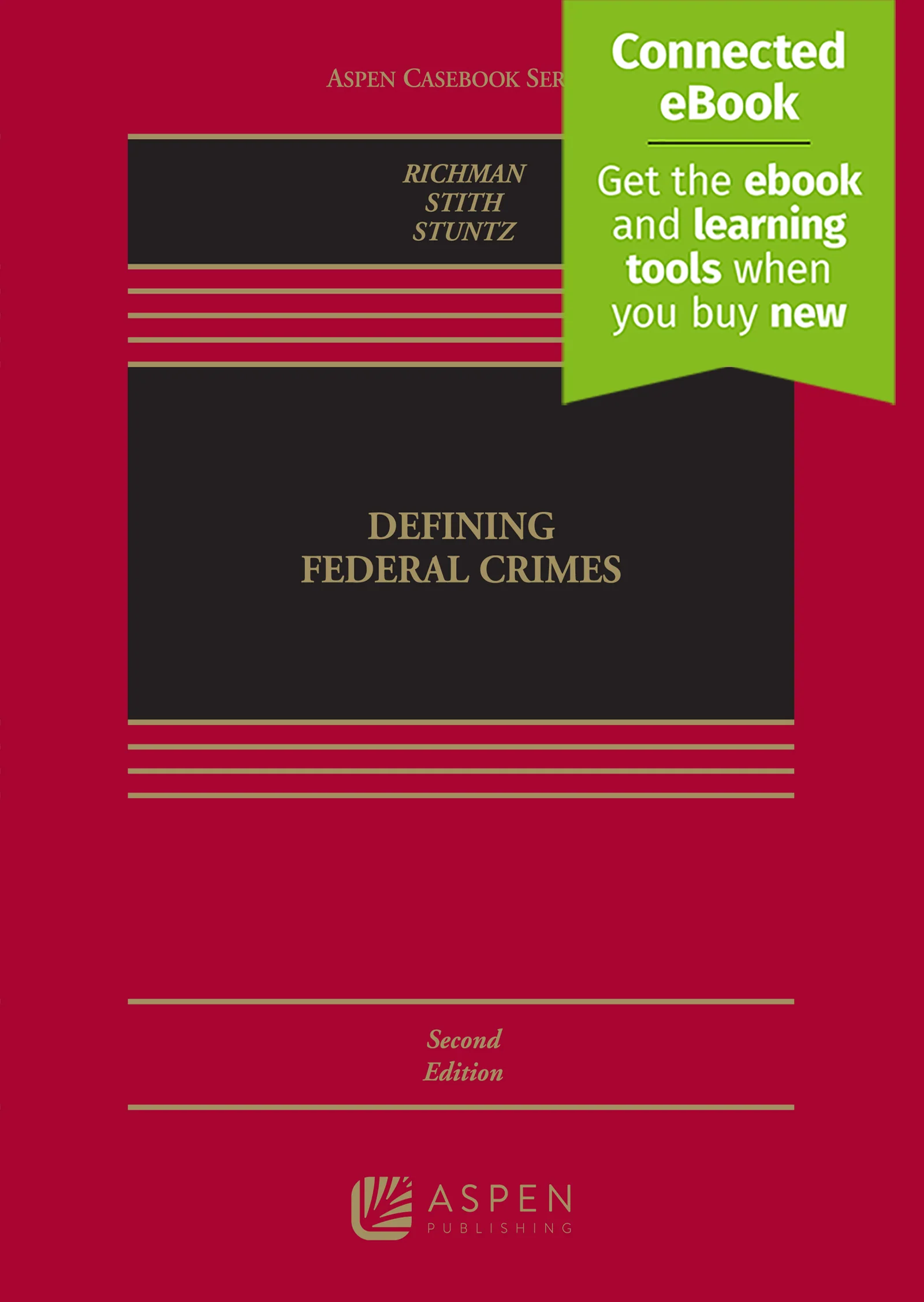
Defining Federal Crimes, Second Edition
Defining Federal Crimes, Second Edition frames federal criminal law as a distinctive world created and shaped by the interplay between the three branches of the federal government. It provides an overview of basic doctrine while inviting students to explore the many difficult and unsettled questions that continue to perplex judges, prosecutors, defense attorneys, and policymakers. Particularly since students’ basic Criminal Law courses draw on penal laws from any number of jurisdictions, this book will be their first exposure to an actual criminal law system, in which each law-shaping institution can react to the moves of the others.
New to the Second Edition:
- Reorganization of the domestic Commerce Clause section and exploration of the Supreme Court’s aborted engagement with the Treaty Power in Bond v. U.S. (Ch.2)
- Inclusion of the Court’s deployment of the “rule of lenity” in Yates v. U.S. and reorganization of the mens rea section, including Elonis v. U.S. (Ch.3)
- Revisions to highlight the growing tension between the cases precluding mail fraud liability for deceit that “merely” causes the victim to enter into a transaction and those permitting liability an intangible property “right to control” theory (Ch.4)
- Considerable revision to the “under color of official right” extortion sections to accommodate McDonnell v. U.S.; a new case (Ocasio v. U.S.) exploring the interaction between “under color of official right” complicity and victim status in “fear of economic loss” extortion; a new case (U.S. v. Baroni—the “Bridgegate Case”) offering an interesting use of the “misapplication” prong of section 18 U.S.C. 666 (Ch.6)
- New cases emerging from the Matthew Shepard and James Byrd, Jr., Hate Crimes Prevention Act of 2009, including U.S. v. Miller (Ch.7)
- New case (Rosemond v. U.S.) in Aiding and Abetting discussion; a new section on Accessory after the Fact and Misprison of Felony liability, including U.S. v. Olson; substantial revision of Material Support of Terrorism section (Ch.8)
- Substantial updates to Ch.9, including coverage of the opioid crisis and enforcement responses to it; exploration of the Court’s analysis of McFadden v. U.S.; discussion of Congress’s use of its appropriations power to limit the federal prosecution of medicinal marijuana cases, including U.S. v. Kleinman; a new case (U.S. v. Campbell) about the Maritime Drug Law Enforcement Act; a new section on prior felony informations and their use for plea bargaining leverage, including U.S. v. Kupa; new discussion of the charging policies of the Attorneys General and of disparate judicial analyses of narcotics mandatory minimums
- Extended discussions of corporate liability to include recent judicial efforts to oversee deferred prosecution agreements (Ch.11)
- Reorganization of Ch.12, with more attention given to the clash between Chevron deference and the rule of lenity
Defining Federal Crimes, Second Edition frames federal criminal law as a distinctive world created and shaped by the interplay between the three branches of the federal government. It provides an overview of basic doctrine while inviting students to explore the many difficult and unsettled questions that continue to perplex judges, prosecutors, defense attorneys, and policymakers. Particularly since students’ basic Criminal Law courses draw on penal laws from any number of jurisdictions, this book will be their first exposure to an actual criminal law system, in which each law-shaping institution can react to the moves of the others.
New to the Second Edition:
- Reorganization of the domestic Commerce Clause section and exploration of the Supreme Court’s aborted engagement with the Treaty Power in Bond v. U.S. (Ch.2)
- Inclusion of the Court’s deployment of the “rule of lenity” in Yates v. U.S. and reorganization of the mens rea section, including Elonis v. U.S. (Ch.3)
- Revisions to highlight the growing tension between the cases precluding mail fraud liability for deceit that “merely” causes the victim to enter into a transaction and those permitting liability an intangible property “right to control” theory (Ch.4)
- Considerable revision to the “under color of official right” extortion sections to accommodate McDonnell v. U.S.; a new case (Ocasio v. U.S.) exploring the interaction between “under color of official right” complicity and victim status in “fear of economic loss” extortion; a new case (U.S. v. Baroni—the “Bridgegate Case”) offering an interesting use of the “misapplication” prong of section 18 U.S.C. 666 (Ch.6)
- New cases emerging from the Matthew Shepard and James Byrd, Jr., Hate Crimes Prevention Act of 2009, including U.S. v. Miller (Ch.7)
- New case (Rosemond v. U.S.) in Aiding and Abetting discussion; a new section on Accessory after the Fact and Misprison of Felony liability, including U.S. v. Olson; substantial revision of Material Support of Terrorism section (Ch.8)
- Substantial updates to Ch.9, including coverage of the opioid crisis and enforcement responses to it; exploration of the Court’s analysis of McFadden v. U.S.; discussion of Congress’s use of its appropriations power to limit the federal prosecution of medicinal marijuana cases, including U.S. v. Kleinman; a new case (U.S. v. Campbell) about the Maritime Drug Law Enforcement Act; a new section on prior felony informations and their use for plea bargaining leverage, including U.S. v. Kupa; new discussion of the charging policies of the Attorneys General and of disparate judicial analyses of narcotics mandatory minimums
- Extended discussions of corporate liability to include recent judicial efforts to oversee deferred prosecution agreements (Ch.11)
- Reorganization of Ch.12, with more attention given to the clash between Chevron deference and the rule of lenity
Original: $266.00
-65%$266.00
$93.10Description
Defining Federal Crimes, Second Edition frames federal criminal law as a distinctive world created and shaped by the interplay between the three branches of the federal government. It provides an overview of basic doctrine while inviting students to explore the many difficult and unsettled questions that continue to perplex judges, prosecutors, defense attorneys, and policymakers. Particularly since students’ basic Criminal Law courses draw on penal laws from any number of jurisdictions, this book will be their first exposure to an actual criminal law system, in which each law-shaping institution can react to the moves of the others.
New to the Second Edition:
- Reorganization of the domestic Commerce Clause section and exploration of the Supreme Court’s aborted engagement with the Treaty Power in Bond v. U.S. (Ch.2)
- Inclusion of the Court’s deployment of the “rule of lenity” in Yates v. U.S. and reorganization of the mens rea section, including Elonis v. U.S. (Ch.3)
- Revisions to highlight the growing tension between the cases precluding mail fraud liability for deceit that “merely” causes the victim to enter into a transaction and those permitting liability an intangible property “right to control” theory (Ch.4)
- Considerable revision to the “under color of official right” extortion sections to accommodate McDonnell v. U.S.; a new case (Ocasio v. U.S.) exploring the interaction between “under color of official right” complicity and victim status in “fear of economic loss” extortion; a new case (U.S. v. Baroni—the “Bridgegate Case”) offering an interesting use of the “misapplication” prong of section 18 U.S.C. 666 (Ch.6)
- New cases emerging from the Matthew Shepard and James Byrd, Jr., Hate Crimes Prevention Act of 2009, including U.S. v. Miller (Ch.7)
- New case (Rosemond v. U.S.) in Aiding and Abetting discussion; a new section on Accessory after the Fact and Misprison of Felony liability, including U.S. v. Olson; substantial revision of Material Support of Terrorism section (Ch.8)
- Substantial updates to Ch.9, including coverage of the opioid crisis and enforcement responses to it; exploration of the Court’s analysis of McFadden v. U.S.; discussion of Congress’s use of its appropriations power to limit the federal prosecution of medicinal marijuana cases, including U.S. v. Kleinman; a new case (U.S. v. Campbell) about the Maritime Drug Law Enforcement Act; a new section on prior felony informations and their use for plea bargaining leverage, including U.S. v. Kupa; new discussion of the charging policies of the Attorneys General and of disparate judicial analyses of narcotics mandatory minimums
- Extended discussions of corporate liability to include recent judicial efforts to oversee deferred prosecution agreements (Ch.11)
- Reorganization of Ch.12, with more attention given to the clash between Chevron deference and the rule of lenity